
On a first deal, most investors shop for a loan the way they shop for a mortgage: they look for the lowest rate. Fix and flip loans for beginners sit in a fairly narrow rate band across the market, so that number rarely decides the deal.
What actually breaks a first project is a mismatch between your deal and your lender’s operating model. A simple cosmetic refresh needs different support than a heavy structural rehab, an unusual property, or a contract that closes in seven days.
If you’re evaluating a fix and flip loan for your first deal, this guide walks through the three types of lenders you’ll come across and how to tell which one fits your deal type. It also covers the specific questions to ask before you sign, so you don’t find out the hard way that your lender’s model doesn’t match your project
Fix and Flip Loans for Beginners: Where Private Capital Comes From
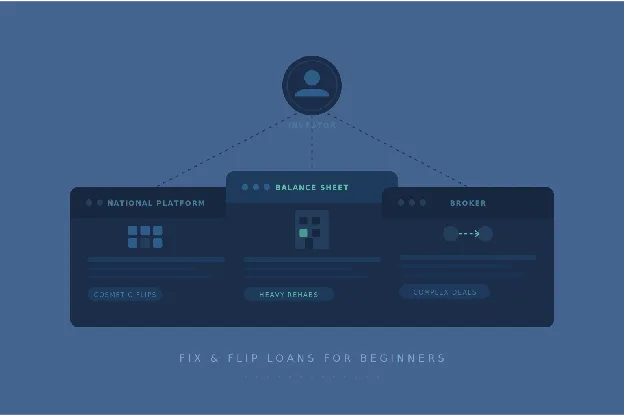
Not all private lenders work the same way. They all offer short-term, asset-based loans, but their capital source shapes how flexible they can be once you’re under contract.
National platforms, such as Kiavi, LendingOne, New Silver, and Lima One Capital, lend using warehouse lines or outside investor capital. Many plan to sell your loan after closing, so your deal has to fit that eventual buyer’s criteria too. This model runs on automation and standardized underwriting. It works well for clean, cosmetic deals and moves fast when your file fits the template.
Balance sheet lenders, such as Stormfield Capital and RCN Capital, fund loans from their own capital. An underwriter reviews your file directly and can make judgment calls on unusual scopes. This model tends to suit heavier rehabs and deals that need a human decision, not just a data match.
Brokers don’t lend their own money. They match your deal to a national platform, a balance sheet lender, or a private fund in their network. Because a broker isn’t the capital source, your question travels through them before it reaches a decision-maker.
What Does a First-Time Fix and Flip Investor Need From a Lender?
Six things matter more on your first deal than the rate.
A real advisor on the phone. This is the single biggest factor, and the easiest one to test before you commit. A first project throws off constant questions: a contractor wants payment before the work is done, an inspection slips a week, the scope changes because of something behind a wall. Each question needs a real decision, and you can’t yet tell which ones are urgent.
National platforms often route your question into a queue, because a small team supports thousands of files. Brokers pass your question along to whichever lender holds your loan. A lender who assigns you a person, someone who already knows your file, can usually answer in one call. Call your shortlist before you apply. Ask something specific about your deal. Whoever gives you a real answer is showing you what the next six months will feel like.
A lender who reviews your renovation plan. Some lenders look only at the property and the exit number. Others read your scope of work, your timeline, and your contractor’s estimate, then tell you what they think. Many lenders will ask you to hold back a contingency. That money covers what a first renovation always turns up: bad wiring, a roof needing more than a patch. It isn’t a fee. It’s a buffer against running out of cash halfway through the job.
A lender who tells you what the loan actually costs. Ask a lender to walk you through every cost before you apply, not after. A rate that looks low can still carry a heavy load: an extension fee if you run past your term, a charge for every inspection, a fee each time the lender releases funds. A lender who lists these upfront, unprompted, is showing you they won’t add surprise costs later. One who only answers when pushed is more likely to spring fees at closing.
Certainty of close. Chase the highest leverage and you take on risk you can’t absorb. Some lenders cut the loan amount or push the closing date days before you sign. An experienced investor can absorb that, because they have other capital and other lenders lined up. On a first deal, you don’t have that cushion; you lose your deposit and the deal. Take the smaller loan from the lender who closes when they say they will.
A draw process you understand before you sign. Lenders release rehab funds in stages after each inspection, so you pay for the work first and get reimbursed after. That catches most first-time borrowers off guard. The draw schedule itself isn’t the problem. What matters is whether the lender tells you upfront where a draw can stall: a slow inspection, a paperwork bounce-back, a dispute over how much work is actually done. Ask a lender to walk you through their process end to end, including where it usually breaks.
Experience with your kind of deal. A lender who funds hundreds of cosmetic flips will spot problems in yours before they get expensive. A lender who mostly finances ground-up construction may not know what to look for in a kitchen gut job. Work out your deal type first: cosmetic, structural, ground-up, or unusual, then match your lender to that category. A lender who forces every deal through one underwriting model will eventually force yours into a box it doesn’t fit, and that box costs you time, money, or both.
The Hidden Cost of Chasing the Lowest Rate
Rate differences matter less than what they don’t cover. Delays on a first flip usually trace back to one of a few places: something hidden behind a wall, a slow draw inspection, a contractor running behind, bad weather, or a stalled permit. A required reserve and an in-house draw process both target the first two directly, which is exactly why they matter more than a small rate gap.
Here’s what that looks like in dollars, on an illustrative $300,000 loan, six months, interest-only:
| No-Reserve Model (10% rate) | Reserve-Required Model (11% rate) | |
|---|---|---|
| 6-month interest | $15,000 | $16,500 |
| Cost of a structural surprise | $4,362 (6-week delay) | $0 (reserve covers it) |
| Total | $19,362 | $16,500 |
On a clean deal, the lower rate wins by $1,500. But a $15,000 structural surprise forces a budget renegotiation without a reserve, and that delay costs more than the rate saved. A 1% rate gap is a small, fixed number. A missing reserve is a variable, uncapped one, and a first flip is more likely than not to hit at least one surprise.
Which Lender Fits Your Deal?
Search for the best hard money lenders for first-time investors, and you’ll mostly find the biggest names, not necessarily the right one for your project.
National platforms run standardized underwriting at volume. They suit clean, cosmetic deals with clear comps. Balance sheet lenders look at each deal individually and can flex on scope, credit, or timeline. Neither is better. They fit different situations.
A standard cosmetic flip usually doesn’t need a human underwriter. A heavy rehab or an unusual property usually does. A tight closing window can work with either type — ask about the lender’s actual approval process, not just their advertised speed.
If your credit, entity structure, or deal doesn’t cleanly fit either model, a broker can be the faster path; they exist to place exactly the deals a standard underwriting box rejects.
A Few Numbers Worth Knowing Before You Apply
Rate isn’t the only thing that varies by lender. Minimum credit scores across the market start around 600 and climb into the mid 600s for some lenders. Entity rules vary too: some lenders require an LLC or corporation, others will lend to an individual. Many lenders set no minimum experience requirement for a first deal. A smaller number ask for at least one prior exit.
None of this shows up in a headline rate, and all of it can change what a loan actually costs you to use.
Questions to Ask Before Your First Flip
- What value do you lend against: purchase price or after-repair value? The same percentage against a different number is a very different loan.
- Who determines that value? A third-party appraisal, an in-house opinion, and an automated model can each land in a different place.
- What’s my total cost from closing to payoff? Points, processing, inspections, and extension fees add up fast.
- Is there a minimum interest period? Exiting early on a loan with one can cost you interest you never used.
- How are draws released, and what’s the typical turnaround? Ask this before you sign, not after your contractor is waiting on a check.
- Do you fund this yourself, or is it sold or brokered? This decides who you deal with after closing.
Red Flags for First-Time Borrowers
- Firm terms offered before anyone reviews your scope of work
- Any real fee requested before a term sheet exists
- Costs that aren’t in writing
- Draws funded below the agreed amount
- Terms changing after a commitment letter
- No straight answer on whether you’re speaking to the actual capital source
Where Stormfield Fits Into This
Stormfield Capital funds loans from its own balance sheet and underwrites and services every loan in-house, so the person you speak to knows your file from application through final draw. We work with first-time investors and don’t require completed deals, though newer borrowers should expect a slightly lower leverage point or higher reserves. That’s one lender’s model. Ask the same questions of any lender on your list, and choose based on the answers.
Fix and Flip Loans for Beginners: FAQs
Can you get a fix and flip loan with no experience?
Yes. Most private lenders set no minimum experience requirement, though a few ask for at least one completed exit. Expect a lower leverage point and higher reserve requirements than an experienced borrower would get.
Can beginners get approved with average credit?
Often, yes. Published minimums across the market start in the low 600s, and many lenders weigh credit alongside deal quality and liquidity rather than using it as a hard cutoff.
What do first time fix and flip loans typically require?
Requirements are usually published, so you can shortlist before you call. Expect entity rules that vary by lender, a liquidity requirement separate from your down payment, and a leverage ceiling tied to your experience tier.


