
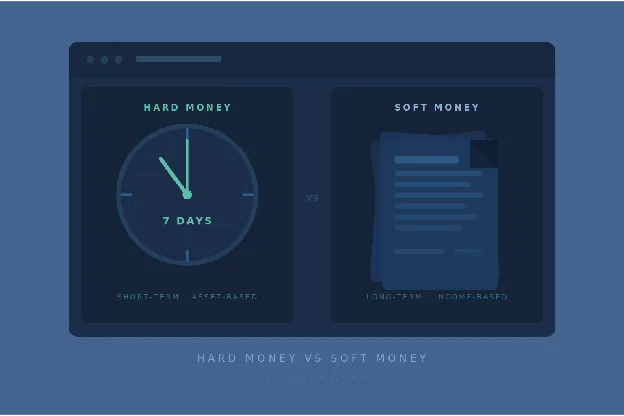
Hard money and soft money sound like slight variations of the same financing tool. However, in real estate lending hard money is commonly used for short-term investments in which a property is acquired, renovated, completed, or repositioned before sale or refinancing. “Soft money” is a less standardized term. Some lenders use it for a hybrid product that sits between hard money and conventional financing, while others use it more broadly for traditional-style real estate financing.
What Is a Hard Money Loan, and How Does It Work?
A hard money loan is generally short-term financing secured by investment real estate. It is commonly used for fix and flip, bridge, construction, value-add, and other situations where the property is expected to change before the loan is repaid.
The property and deal economics carry significant weight in underwriting, but lenders may also review borrower experience, liquidity, credit, project scope, and the proposed exit.
What does a hard money lender actually underwrite?
Hard money is often described as asset-based lending, but that does not mean the lender looks only at the property. For a transitional deal, underwriting may consider the purchase price, current and projected value, renovation or construction scope, borrower experience, liquidity, local market, and expected exit.
The mix varies by lender, but the central question is whether the property and the borrower’s plan support the requested financing.
Does hard money require good credit?
Credit can still matter in a hard money loan, but lenders may weigh it alongside liquidity, experience, leverage, the property, and the exit strategy. Some programs have minimum credit requirements, and others do not.
So “hard money” should not be treated as another term for “no credit check.”
What Is the Difference Between Hard Money and Soft Money?
Soft money does not have one universal definition in real estate lending. Some lenders use it for financing that combines elements of hard money and conventional lending, while others use it more broadly for conventional-style investment financing.
So the comparison below reflects how soft money is commonly marketed, not a fixed industry definition.
What is soft money in real estate lending?
Soft money is commonly used for financing that sits closer to longer-term investment-property debt. Compared with hard money, these products may place greater emphasis on borrower credit, income, or existing property cash flow and may offer longer terms.
For example, some lenders market soft-money products with multi-year or 30-year structures rather than the short terms used for transitional hard-money deals.
A soft-money loan is also different from soft terms or a soft quote, which simply describe an early indication of potential financing terms.
How do hard money and soft money loans differ?
| Factor | Hard Money | Soft Money, as commonly marketed |
|---|---|---|
| Typical purpose | Transitional or time-sensitive property | Stabilized or longer-term investment |
| Loan term | Shorter | Longer |
| Underwriting focus | Property, project, exit, and borrower strength | More emphasis on borrower credit, income, or property cash flow |
| Property condition | Can support renovation, construction, or repositioning | More commonly associated with stabilized or near-stabilized assets |
| Closing speed | Generally structured for faster execution | Usually involves more underwriting |
| Typical exit | Sale or refinance after completing the business plan | Longer-term hold or later refinance |
| Common use | Fix and flip, bridge, construction, value-add | Rental or longer-term investment financing |
These are market tendencies, not universal rules. Individual lenders can use the same label for different products.
When does a deal point toward hard money or soft money?
A property that needs substantial renovation before sale or refinance points toward a different financing need from a stabilized rental intended for a long hold.
Hard money is commonly built around the first situation: finance a defined period of acquisition, renovation, construction, or repositioning. Soft-money products are more often marketed for assets that are already stabilized or closer to their intended long-term condition.
The key question is what needs to happen to the property before the loan is repaid.
Worked Example: Why a Distressed Fix and Flip Fits Hard Money
A Stormfield transaction in Hingham, Massachusetts shows the distinction in practice. Stormfield funded a $1.62 million, 12-month Fix & Flip loan for the acquisition and renovation of a distressed single-family investment property that required substantial work.
The financing supported a defined transition: acquire the property, complete the renovation, create value through the work, and reach the next exit within the loan term. That is the type of business plan short-term hard money is designed to support.
The published transaction does not establish that another type of lender would have rejected the property. It shows why the deal itself fits a short-term, transitional financing structure.
Where Stormfield Fits in the Hard Money vs. Soft Money Comparison
Stormfield sits on the short-term private lending side of this distinction.
Stormfield provides business-purpose financing secured by investment real estate. Its current residential programs include Fix & Flip, Residential Bridge, New Construction, and Multifamily Value-Add financing. These programs are designed for acquisitions, renovations, construction, bridge needs, and other transitional real estate strategies.
Stormfield uses balance-sheet capital, with underwriting, credit decisions, and servicing handled in-house. Its lending model therefore aligns with short-term hard/private money rather than the longer-term hybrid products commonly marketed as soft money.
Does Stormfield offer DSCR or soft money products?
Stormfield’s current published programs do not include a long-term DSCR or soft-money product. Its focus is short-term financing for investors and developers acquiring, renovating, constructing, bridging, or repositioning real estate.
A borrower seeking long-term financing for a stabilized rental is therefore solving a different financing need from the borrower Stormfield’s programs are designed to serve.
Choose the Financing Based on the Deal, Not the Label
Hard money and soft money are useful labels, but the financing decision should start with the deal. Property condition, renovation or construction needs, required closing speed, hold period, and exit all matter.
Short-term hard money may fit when the borrower needs to acquire, improve, construct, or reposition a property before sale or refinance. A stabilized asset intended for a longer hold may call for a soft-money or conventional-style structure instead.
Frequently Asked Questions
Is soft money the same as a conventional loan?
Not always. Some lenders use “soft money” to describe a hybrid product that sits between hard money and a conventional mortgage. Others use the term more broadly for traditional-style financing.
Is hard money always more expensive than soft money?
Hard-money products are generally structured differently from longer-term financing, and lenders marketing soft-money products often position them with lower rates and longer terms. But pricing varies by lender, borrower, property, leverage, and loan structure.
Is Stormfield Capital a soft-money lender?
Stormfield is not a soft-money lender. Their programs focus on short-term, business-purpose financing for real estate investors and developers. Its current program lineup does not include a soft-money product.


