
According to the American Association of Private Lenders (AAPL), there were 5,407 private real estate lenders active in the U.S. in 2023. The top ten accounted for only about 23% of total loan volume. One out of every four lenders you find today didn’t exist a year ago.
That fragmentation is the whole problem. Most investors respond to it by doing what they’d do for a mortgage: they compare interest rates and stop there. On a hard money fix and flip deal, the rate is one line item. It doesn’t tell you whether your hard money loan gets sold to a third party after closing, how fast a draw actually clears once an inspector signs off, or what happens when a renovation uncovers something your contractor didn’t budget for.
What is a fix and flip lender, and how does hard money fit in?
A fix and flip lender provides short-term, asset-based financing to investors who buy, renovate, and resell property. The loan is underwritten against the deal: purchase price, renovation budget, and projected resale value. Not against the borrower’s income or job history.
How is a fix and flip lender different from a bank?
A bank underwrites you. A fix and flip lender underwrites the deal. That one difference drives everything downstream: how fast a decision comes, what paperwork you hand over, and who qualifies in the first place.
Because the underwriting is asset-first, hard money lenders move quickly and can say yes to borrower profiles a bank would decline before the conversation started. A first-time investor with a strong deal and enough cash on hand can get approved where a 45-day bank process wouldn’t even begin.
Is a hard money lender the same as a fix and flip lender?
In practice, close enough. Hard money is the broader term for any loan secured by the property itself rather than the borrower’s income. Fix and flip is one use case inside that category, alongside bridge loans, ground-up construction, and other short-term investment financing.
The label rarely changes the deal. What matters more is how the lender is funded and how it operates, and you won’t always see that on the homepage.
If you want the fuller picture of how hard money, bridge, private, and fix-and-flip map onto each other in a real deal, we’ve broken it down scenario by scenario in Hard Money vs. Bridge vs. Private: Lending Terms Explained.
What are the different types of hard money fix and flip lenders?
There are five broad types: direct balance sheet lenders, national private lenders, regional private lenders, correspondent lenders, and brokers. They differ in where the money comes from, and that determines how fast a decision comes, how much room there is for an unusual deal, and who picks up the phone six months in.
| Type | Capital Source | Decision Speed | Flexibility | Best Suited For |
|---|---|---|---|---|
| Direct / Balance Sheet | Own capital | Fastest | Highest | All deal types, including unconventional ones |
| National Private Lender | Warehouse lines, institutional funds | Fast for standard deals | Low, has to fit the box | High-volume, standardized deals |
| Regional Private Lender | Mix of own and outside capital | Fast, with local knowledge | Moderate | Investors in a defined geographic market |
| Correspondent Lender | Capital partner’s funds | Moderate | Low, conforms to the partner’s rules | Borrowers whose deals fit standard criteria |
| Broker | Doesn’t fund; matches you to a lender | Depends on the lender they place you with | Depends on that lender | Borrowers who need help navigating the market |
Direct / balance sheet lenders
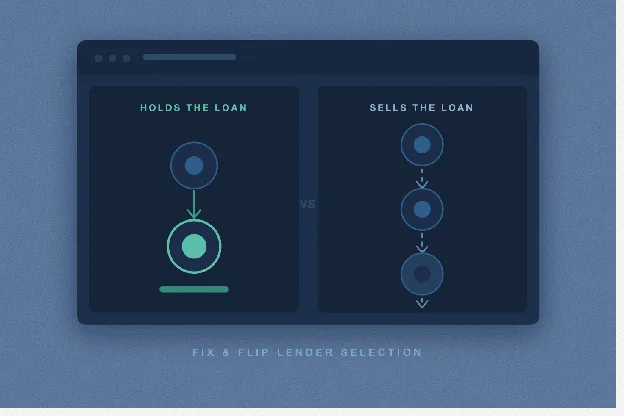
They fund loans with their own capital and hold them through payoff. Every credit decision and every draw approval stays with one team. Because no outside buyer has to bless the file, this is the model with the most room to approve a deal that doesn’t fit a template, and the fewest handoffs after you close.
National private lenders
They fund through warehouse lines or institutional capital, which usually means your loan is sold shortly after closing. Your deal has to satisfy the eventual buyer’s criteria as well as the originator’s. That’s a tradeoff: it works well for a clean cosmetic deal that fits the template, and poorly for anything that doesn’t.
Regional/local private lenders
They mix their own capital with outside money and concentrate on a defined footprint. What you’re buying is local knowledge: which townships take four weeks to issue a permit and which take four months, and what a finished comp actually trades for on that street. The tradeoff is reach. If you buy across five states, they can’t follow you.
Correspondent lenders
They originate the loan but fund it with a capital partner’s money and work inside that partner’s rules. You get a local point of contact with somebody else’s credit box behind them. That’s fine when your deal fits standard criteria. It gets frustrating when it doesn’t, because the person you’re talking to isn’t the person who can make the exception.
Brokers
They don’t lend. They place your deal with a lender who does and take a fee for it. A good broker earns that fee by knowing which lenders actually fund which deal types, which saves real time if you’re new to a market. The cost is a layer between you and the decision-maker, and that layer is most expensive exactly when you need a fast answer.
The lender that’s right for your first duplex in Bridgeport is rarely the lender that’s right for someone doing eight flips a year across three states. Most of what follows splits along that line, so be honest about which side you’re on: the first-timer working deal one or two, probably around a full-time job, or the repeat operator who has already felt what it costs when a draw gets stuck.
Want to see how this plays out in published numbers rather than category descriptions?
Fix and Flip Funding: Lender Requirements in 2026 lines up FICO minimums, experience requirements, and documentation across six active lenders, so you can see exactly what each type demands before you pick up the phone.
What should a first-time investor look for in a hard money lender?
What does a lower rate actually save you?
The quoted rate is real, and it’s the easiest cost to compare before closing. But it isn’t the whole cost. Here’s what it leaves out.
On a $300,000 loan at 10%, interest runs $2,500 a month. A full point of difference over six months is $1,500. Six weeks of dead time waiting on a draw is $3,750, before taxes, insurance, and utilities. Both are real money. Only one of them is on the rate sheet.
So compare rates. Then ask the questions that price the rest of it: how long does a draw take from inspection to wire, what happens when the scope changes mid-project, and who holds the loan six months in.
Four things decide a first deal
None of them show up on a rate sheet.
- Someone who reads the renovation plan, not just the ARV. If nobody asks what’s behind the walls of a 1940s colonial before quoting you, they aren’t underwriting the project. They’re underwriting the exit and hoping.
- A real advisor on the phone. A fast digital application and a fast decision aren’t the same thing.
- A draw process you understand before you sign. Ask for the sequence: who inspects, how soon after you request it, how long from sign-off to wire.
- A lender that actually does your deal type. Cosmetic, structural, ground-up, and unusual are four different underwriting problems. Plenty of lenders do the first and quietly decline the rest.
On that second point, Stormfield built its platform to remove the paperwork, not the relationship. Document collection, status updates, and signatures run through the platform, so the underwriting team can focus on your actual file instead of chasing it. Because Stormfield funds and services the loan itself, the person who reviews your deal is still the person who answers when a permit stalls six weeks later.
Can I get a fix and flip loan with a mediocre credit score?
Usually, yes. Credit worries stop more first-timers from applying than they should. Hard Money fix and flip underwriting weighs the deal and your liquidity more heavily than a score. That’s a real structural difference, not marketing: the collateral is what secures the loan.
It isn’t the same as “no credit check”. No legitimate lender skips credit review entirely. It’s one input among several, not a single gate. Published minimums across the market start around 600; Stormfield’s own baseline sits around 640, weighed against the deal rather than applied as a hard cutoff on its own.
What should a repeat or scaled operator prioritize?
You already know how to run a project. What you’re actually buying at this stage is reliability: a lender who keeps your loan on their books instead of selling it, knows your submarket, and gets easier to work with over time instead of resetting the relationship with every file.
Why capital source predicts whether a draw moves
A lender that sells your loan after closing has a buyer to satisfy, and that buyer’s appetite isn’t fixed.
This isn’t a theory. The American Association of Private Lenders found that originating to sell on the secondary market is the industry’s most common strategy, and that the arrangements behind it are mostly soft commitments rather than contractual guarantees. When rates spiked in late 2022, plenty of originators discovered what that means: buyers stepped back, and loans they’d counted on offloading had nowhere to go. AAPL’s own comparison found that lenders funding from their own capital held origination volume far more steadily than lenders running high leverage on the secondary market.
Translated to your deal: a lender whose capital tightens when the market moves is a lender whose draws slow down at the same time your carrying costs are rising. A balance sheet lender doesn’t hand your file to a third party the moment you close, which matters most exactly when a draw needs to move this week.
Why submarket knowledge beats national coverage
An underwriter who has closed deals on your streets prices off real comps instead of a state average, and knows which building departments run four weeks behind. That shows up as fewer questions on the file and fewer surprises in the schedule. Stormfield concentrates in the Northeast for this reason, and lends selectively in markets where the team has built the same depth. Deep knowledge of a handful of markets beats shallow coverage of all fifty.
What does capital structure change on a live deal?
On a clean deal that closes on schedule, most lenders look the same. The difference shows up when something moves. An investor in Orwigsburg, PA found a flip with a tight closing deadline. Not a total beginner, but a small outfit: one prior flip and a few rentals. The deal: purchase in the low $200,000s, $75,000 budgeted for renovation, targeting a mid-$300,000s ARV.
For Stormfield, that profile mattered as much as the numbers. One completed exit and a defined scope mean the borrower doesn’t need the hand-holding a true first-timer needs, but they also hadn’t built the multi-deal record that unlocks the fastest approval path. Stormfield funded the deal off its own balance sheet.

Over six months, the borrower submitted four draw requests. Each one cleared without the back-and-forth that a sold loan or a layered-approval lender would have introduced, because the same team that underwrote the file also approved the draws. The property sold for $374,900, ahead of the initial target.
What questions should you ask, in what order?
Ask in the order your deal actually needs. Most lender conversations go wrong because the borrower runs a generic list instead of leading with the thing that would kill this specific project.
Four priorities, and the question that opens each one:
- Certainty of close. “Is this approval conditional or firm, and what could still change it?”
- Total cost. “Walk me through every fee, including extension and prepayment, in writing.”
- Draw execution. “From the day I request a draw, how many days until the wire lands?”
- The long relationship. “Do you hold and service this loan yourself, or does it get sold?”
Rank those four for the deal in front of you, and you’ll have a call agenda. The tool below builds the full ordered checklist from your ranking.
Step 1 of 2
Set your priorities
Rank what matters most on your deal, then get a single ordered checklist to run through with every lender you’re comparing.
- Certainty of close
- Total cost
- Draw execution
- Relationship over time
Step 2 of 2
Your lender checklist
Start at the top and check off each question as you discuss it with your lender.
What are red flags to watch for in a fix and flip lender?
Most of them are visible before closing, if you ask.
- Soft approvals treated as commitments. A term sheet issued before the file’s fully reviewed can still change before closing. Ask directly whether an approval is conditional or firm.
- Fixed review cycles that ignore where your project actually stands. Some lenders inspect and fund draws on a rigid two-week schedule no matter what. That creates cash flow gaps that stall contractors.
- Draws funded below the agreed amount, forcing you to bridge the gap with personal cash. Confirm draw funding terms in writing before closing.
- Terms that change after a commitment letter. If a lender moves the rate or the leverage after committing, they don’t stand behind the deal.
- Costs that aren’t disclosed in writing. Every fee, every prepayment penalty, every extension cost should be explainable before you sign, not discovered at closing.
- No straight answer on who actually holds the capital. If a lender can’t tell you plainly whether they fund and hold the loan or sell it, that’s the answer.
Frequently Asked Questions
1 What’s the difference between a fix and flip lender and a hard money lender?
Very little in practice. Hard money describes any loan secured by the property rather than the borrower’s income. Fix and flip is one use case inside that category, alongside bridge and ground-up construction. What separates lenders isn’t the label, it’s whether they lend their own capital and keep the loan after closing.
2 Can I get a fix and flip loan with no experience?
Yes. Most private lenders set no minimum experience requirement, though some ask for at least one completed exit. Expect lower leverage and a higher reserve requirement than an experienced borrower would get.
3 Can I get approved with average or less than perfect credit?
Often, yes. Published minimums across the market start around 600 and climb into the mid-600s, and most lenders weigh credit alongside deal quality and liquidity rather than treating it as a cutoff. No legitimate lender skips credit review entirely, so treat “no credit check” advertising as a warning.
4 What’s the difference between a balance sheet lender and a conduit lender?
A balance sheet lender funds from its own capital and services the loan in-house through payoff. A conduit lender sells the loan into the secondary market after closing, which means your underwriter, your draw manager, and your servicing contact are unlikely to be the same team, or even the same company, six months in.
5 Is the interest rate the most important factor?
It’s the most comparable factor, which isn’t the same thing. Compare rates first, then ask about the costs a rate sheet can’t show: draw turnaround, extension terms, and whether the loan stays with the team that wrote it.
Ready to Work With a Lender Built for Execution?
Stormfield Capital is a direct balance sheet lender with in-house underwriting and in-house servicing. The team that approves your deal is the same team that manages your draws through final payoff, no handoffs, no third-party servicer picking up your file halfway through.


