
Building a hard money brokerage is not the same as placing hard money deals.
Plenty of brokers place deals. They field calls, submit files, chase lenders, and collect a fee when something closes. That is a transaction. What they are building is not necessarily a business.
A scalable brokerage functions as a system. It has a defined focus on deal types and a vetted lender roster. You can repeat the submission process. Referrals bring you deals even between deals.
Building a brokerage requires three deliberate choices.
The first is which deal you pursue. The second is which lenders you commit to. The third is how you protect your fee every time.
The Hard Money Brokerage Model
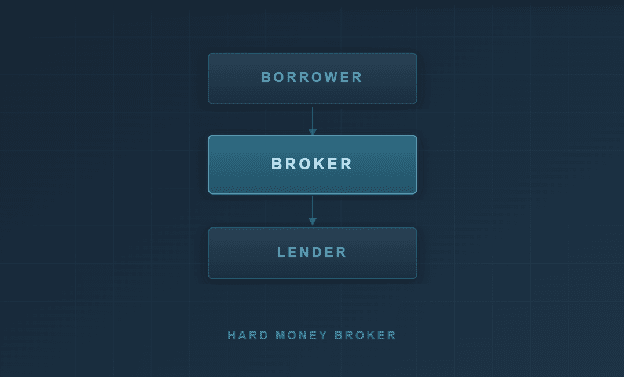
A hard money brokerage earns money by connecting borrowers who need fast, asset-based loans with direct lenders. The broker does not lend money. They find borrowers, check them, prepare the deal, and connect them with lenders. The broker earns a fee when the lender funds the loan.
Compensation usually follows three paths:
- An origination fee, usually 1 to 2 points of the loan amount, is paid by the borrower at closing.
- A yield spread premium is different. You charge a higher rate than the lender requires. You keep the extra.
- A flat finder’s fee for hands-off referrals where the broker’s involvement ends at introduction.
Most brokers use a mix based on the deal, the lender, and how involved they are.
What matters most is this: you must clearly show and secure your fee in the closing statement before the deal closes. In private lending, that closing statement takes different forms.
In private lending, that closing statement takes different forms.
Lenders and brokers still use the HUD-1 Settlement Statement1 for commercial loans and investment properties. The statement covers most hard money deals.
You will also see the ALTA Settlement Statement2. Some lenders use their own list. They do not follow a standard form. The document depends on the lender and the title company.
But one thing does not change. Your fee must be in writing before closing.
Regulators set compensation rules for conventional loans, and lenders follow strict guidelines. They treat relationships as transactional. Hard money brokering works differently.
In private lending, lenders set their own guidelines. Brokers negotiate compensation for each deal. They close deals by building strong relationships with lenders, not by relying on a rate sheet.
Choosing Your Lane: Which Deal Types Suit Hard Money Broker Origination
Not every hard money deal is equal for a broker. The type of deal you focus on shapes everything. It decides which lenders you need, how long deals take, how much you earn, and how much competition you face. Building a brokerage without a clear lane is how brokers end up with a lender roster that doesn’t match their deal flow.
Here is how the four primary deal types break down from a broker’s perspective:
| Deal Type | Volume | Cycle Length | Average Fee | Lender Pool | What It Rewards |
|---|---|---|---|---|---|
| Fix and Flip | Highest | 6 to 93 months | Moderate | Large, competitive | Speed, relationships, volume |
| Ground-Up Construction | Lower | 12 to 18 months | Largest | Small, specialized | Technical knowledge, patience |
| Commercial Real Estate Bridge | Moderate | 6 to 24 months | High | Mid-size, selective | Deal structuring, experience |
| Multifamily Value-Add | Lower | 12 to 24 months | High | Relationship-driven | Long-term borrower relationships |
Fix-and-flip is the most competitive lane for a reason. Volume is high, and lenders are plentiful, which means submission quality and lender relationships are the only real differentiators.
Ground-up construction is where the fees justify the patience. The lender pool is smaller because most fix-and-flip lenders do not touch construction at all.
Commercial real estate bridge has lower broker competition and larger average tickets. A broker who can handle complex commercial deals can do what most others cannot.
Multifamily value-add deals go to brokers who build strong relationships with operators. Brokers who only respond quickly to leads lose these deals.
Pick the lane that matches your existing borrower network. Build depth before breadth.
Scenario: How Much Can a Hard Money Broker Earn Per Deal Type
Ground-up construction attracts fewer brokers.
These deals take longer. Fewer lenders offer them. The underwriting is more complex. Most fix-and-flip lenders do not fund construction deals.
But the numbers tell a different story.
| Fix and Flip | Ground-Up Construction | |
|---|---|---|
| Loan amount | $300,000 | $1,200,000 |
| Broker fee (1.5 points) | $4,500 | $18,000 |
| Average cycle | 6 months | 14 months |
| Deals needed to earn $90,000 | 20 deals | 5 deals |
Twenty fix-and-flip deals in six months need high volume. Five ground-up deals over fourteen months need depth, not volume.
A broker who can review a builder’s track record and plan the draw schedule can earn fees that most others cannot.
The question is not which deal pays more. The question is what fits how you want to build your business.
How to Structure a Deal Package That Gets a Direct Lender’s Attention
A complete file moves directly to underwriting once submitted. Three incomplete submissions over two weeks signal to the lender that deals may fall apart mid-process and that working with you will require extra hand-holding. Direct lenders prioritize brokers who make their job easier.
Start with a one-page summary in your own words. Explain the property, the borrower’s plan, the exit strategy, and why the deal makes sense.
Add a line about your own track record. A lender who knows you deliver clean files moves faster on your submissions.
You should verify everything before you send it to the lender. The borrower should not package the deal and send it to the lender.
Before You Submit: Your Deal Package Checklist
| Item | Your Job as the Broker |
|---|---|
| Executive summary | Write a one-page deal thesis in your own words. Include a line on your track record with this lender type. |
| Entity documents | Confirm your borrower is applying through an LLC. If they aren’t, fix it before you submit. |
| Proof of funds | Verify the down payment, reserves, and closing costs yourself. Do not take the borrower’s word for it. |
| Borrower track record | Pull prior closing statements and project photos. For first-timers, document their contractor and team instead. |
| Property eligibility | Confirm the deal type fits the lender’s program and check zoning and title before the lender does. |
| ARV | Pull your own comps. Do not submit the borrower’s number until you have verified it independently. |
| Scope of work | Cross-reference the budget against contractor bids line by line. Flag any gaps before submission. |
| Exit strategy | Write out specific dates for purchase, construction, listing, and sale. Vague timelines raise flags. |
How to Develop a Direct Lender Relationship, Not Just Use One
Placing a deal with a lender and building a relationship with one are not the same.
The first earns a fee.
The second builds a pipeline, speeds up deals, and keeps the borrower satisfied.
The brokers who build durable businesses operate differently. They treat lenders like builders treat subcontractors. They know them before the deal starts, call them when problems come up, and trust them to respond.
That distinction compounds over time. A lender who knows your work, your borrowers, and your market will move faster and give honest feedback. They will also contact you first when they have capital to deploy. A lender who only knows your name from a deal log will treat you like any other broker.
Getting onto a preferred broker list
Every serious direct lender has an informal tier of brokers they prioritize. Getting on the list is not about volume but consistency. Send complete deals. Be honest about borrowers. Do not oversell. Mention problems early.
A broker who calls out an issue before sending a deal builds more trust in one call. A broker who sends many clean files and then disappears does not.
Testing a new lender before routing your best clients
Never send your most important borrower to a lender you have never closed with. Test on a lower-stakes deal first. Watch how they communicate during underwriting, how they handle a complication, and whether closing terms match the term sheet.
That test deal tells you everything the pitch deck doesn’t.
Communication outside live deals
Stay in touch with the lender between deals. A check-in, a relevant market note, a referral that wasn’t yours to place. Lenders remember brokers who treat the relationship as ongoing. They forget the ones who only call when they need something.
Broker Compensation: How to Disclose It and Protect It
Three conversations that protect your fee
- Before the lender issues a commitment letter: Tell the borrower what you charge, how it is calculated, and where it appears on the closing statement. Do it in writing. If a borrower sees a new fee at closing, they feel deceived, even if the fee was always part of the deal.
- Before you submit: Your fee should appear on the term sheet before you submit the file. If it is not there, ask for it to be added. A fee agreed to verbally but never documented is a fee that disappears.
- Before closing: Check that the commitment letter and closing statement show your fee at the agreed amount.
When a lender tries to cut you out
It happens by omission, not aggression. A lender contacts your borrower directly. Terms shift. By the time you learn, the relationship has moved.
Two protections matter: choose lenders with a formal non-circumvention policy, and use white-labeled documents throughout the process. When your borrower sees your brand on every document, the relationship stays anchored to you.
How Repeat Business Actually Works in Hard Money Brokerage
The most productive hard money brokers do not generate repeat business by staying top of mind. They generate it by making the entire experience, from first call to final payoff, smooth enough that a borrower has no reason to call anyone else next time.
That experience does not end at closing. It runs through every draw request and every communication during the loan term. The lender you placed behind the deal reflects on you long after your active role ends.
Here is how the flywheel actually works:
| What You Do | What the Lender Does | What It Produces |
|---|---|---|
| Place the right borrower with the right lender | Underwrites accurately, funds on time, terms hold at closing | Borrower closes with confidence, no surprises |
| Stay present post-close, check in during the project | Services draws in-house, communicate proactively, resolves issues without tickets | Borrower feels supported, project stays on track |
| Follow up at payoff, ask about the next deal | Releases the loan cleanly, no servicing friction at exit | Borrower returns for the next deal, refers others |
Every referral you receive is the downstream result of a lender performing well during the servicing phase.
A delayed draw costs the borrower money.
A slow service does too.
A loan change that takes weeks can make the borrower leave.
The lender you choose at the start stays with the borrower for the whole loan.
The borrower deals with that lender the entire time.
So lender choice is not just about getting the deal done. It also affects your future business.
Partner With Stormfield Capital
Building a hard money brokerage that scales requires more than deal flow. It requires a lending partner whose structure matches the promises you make to your borrowers.
Stormfield Capital is a true balance sheet lender. Fully flexible capital, in-house underwriting, in-house servicing, and no loan sales or handoffs.
When Stormfield issues a term sheet, the capital is there. If someone requests a draw, the same team that underwrote the deal makes the decision. And when something changes mid-project, you talk to a decision-maker, not a support ticket.
Your fee shows on every commitment letter and closing statement.
And your borrower stays your borrower. The lender experience your client has reflects the standard you set when you placed the deal.
Experienced brokers who have built their business on execution know where to find us.
Ready to build your brokerage with the right lending partner?
Stormfield gives brokers direct access to balance sheet capital, in-house underwriting, and in-house servicing so you can close with more certainty and protect the borrower relationship after funding.
Frequently Asked Questions
How do I protect my broker fee if a lender contacts my borrower directly?
Documentation is your primary protection. Before closing, check your fee on the term sheet, commitment letter, and closing statement. Also, check that the lender has a no-circumvention policy in the broker agreement. Use white-labeled documents so the borrower stays with you, not the lender.
What is the difference between a yield spread premium and an origination fee?
You charge an origination fee to the borrower. It shows on the closing statement as a line item. A yield spread premium is different. You charge a higher rate than the lender requires, and you keep the extra money. Both are legitimate structures. The right choice depends on how involved you are in the deal and how strong your borrower relationship is.
How many lenders do I need before I can start placing deals consistently?
Depth matters more than quantity. Two to three vetted lenders per deal type you actively work in is more valuable than ten lenders you have never tested. Before routing a live deal through any lender, close at least one straightforward transaction with them first. Your pull-through rate with lenders is what gets you on their preferred broker list, not the number of relationships you have.
How do I get a direct lender to prioritize my deals over other brokers?
Submission quality and predictability matter more than volume. Lenders prefer brokers who send complete deals, state issues early, and bring similar types of borrowers. One call where you mention a problem early builds more trust. Ten clean files without context do not. You earn a spot on a lender’s preferred list by being reliable, not just by building relationships.
Footnotes
- Consumer Financial Protection Bureau. What Is a HUD-1 Settlement Statement?
- American Land Title Association. Accessed April 6, 2026. ALTA Settlement Statements.
- Cycle lengths represent general estimated ranges based on typical market experience across deal types. Actual timelines vary by lender, market conditions, borrower experience, and deal complexity.


