
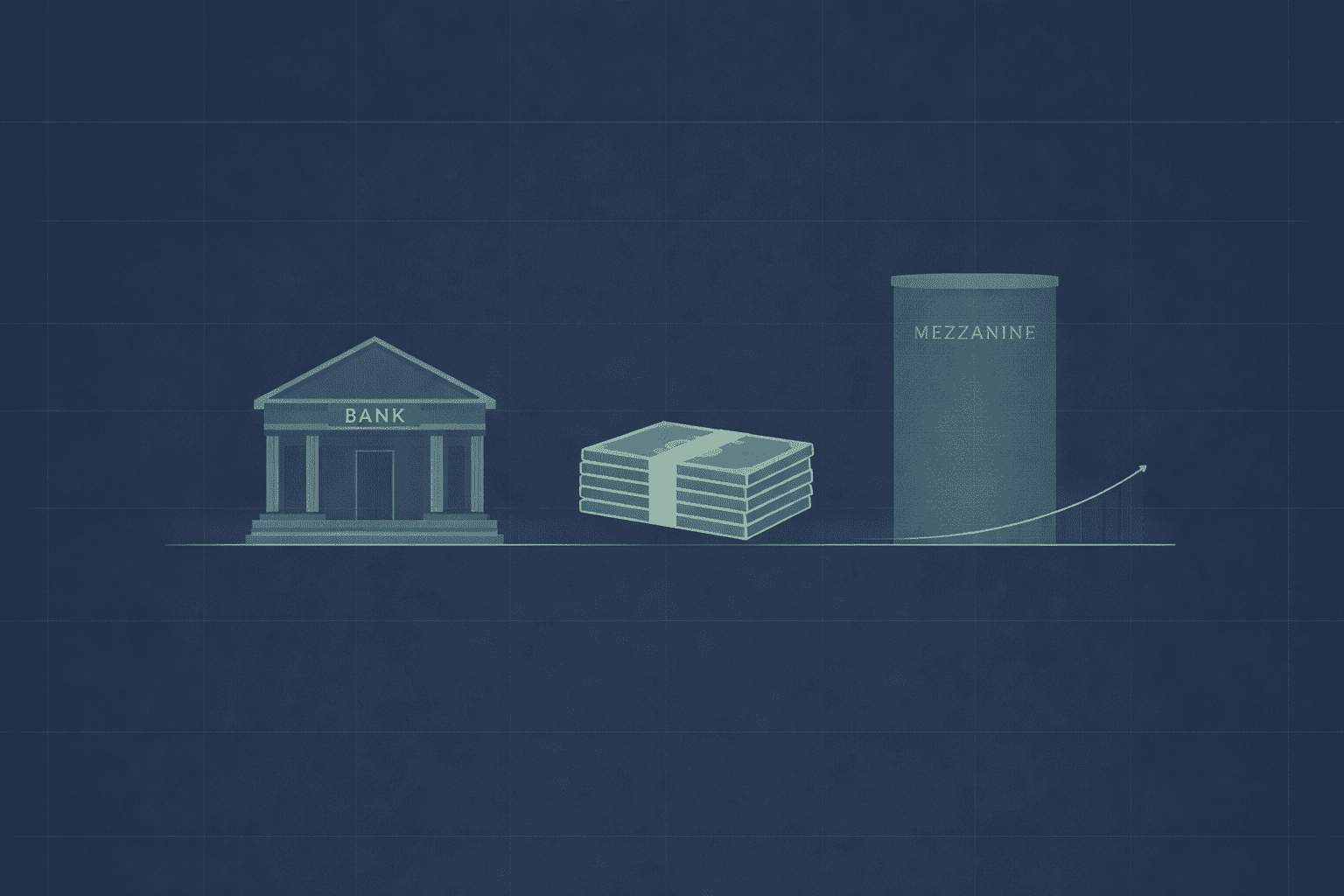
In residential development, how you mix your own cash with borrowed money is more than just a math problem. This mix drives your project’s speed, your personal risk, and, ultimately, your profit.
For experienced builders, the question isn’t just “What is the rate?” but rather “Which loan structure allows me to scale my business?” Here is how to match the right funding tool to your specific project goals.
Bank Construction Loan vs Hard Money: Comparing Speed and Leverage
1. The Bank Loan: Best for High-Liquidity, Low-Risk “Buy and Hold.”
Traditional banks are “depository” lenders. Banks are careful because they are lending out their neighbors’ savings. They are heavily regulated and naturally risk-averse. They aren’t just betting on your project; they are scrutinizing your entire financial life.
When to Use a Bank: You Have Time and Cash
- High Cash-in: You are comfortable tying up 30–35% of the project cost in cash.
- The Planning Phase: You have a 60-to-90-day lead time before you need to move dirt.
- Personal Financial Strength: You have a 700+ credit score and tax returns that show high, consistent income.
The Trade-off: Red Tape and Personal Liability
- The “Lending Box”: Banks have rigid criteria. If your debt-to-income (DTI) ratio is high because you have other active projects, a bank may decline you regardless of how profitable the new deal is.
- The Draw Bottleneck: Banks have been very careful. Any observations from third-party inspectors lead to a longer time to resolve the objections.
- Full Recourse: If the deal goes sideways, the bank can come for your house, your savings, and your personal assets.
2. Private Capital: Built for Speed and Scale
Private lenders operate with a different set of rules. While they value your personal financial score and experience, their primary focus is the deal itself: what the land is worth today and what the finished home will sell for tomorrow. This bridge capital moves you from acquisition to completion at the speed your subs actually work.
The Strategic Fit: When Speed and Leverage Are Your Edge
- Winning the Deal: You need to close in 10–14 days to beat a cash buyer to a prime lot.
- Cash Preservation: You’d rather put down 15–20% to keep your capital liquid for your next acquisition.
- Building More: You have three projects running and don’t want your personal debt to stop you from starting a fourth.
The Trade-off: The Price of Speed
- The Price Tag: You will pay a higher interest rate (typically 8.5% to 12%)[1] to get the leverage and speed that banks won’t give you.
- Execution Windows: These are 12- to 24-month tools. They are designed for “build-and-sell” or “build-and-stabilize” strategies.
At Stormfield Capital, we’ve optimized our Residential New Construction Loans for these exact timelines, ensuring that the “price of speed” is always outweighed by the profit of a finished project.
3. Mezzanine Debt: Filling the Missing Piece
Mezzanine debt fills the gap. It sits behind your senior loan but ahead of your cash.
If a bank provides 70% of the cost and you only want to put up 10% of your own cash, a mezzanine loan fills that middle 20% “gap.”
When to Use It: Large, Complex Deals
- Complex Builds: Best suited for $5M+ developments or large multi-family projects with high total capital requirements.
- Retaining Ownership: You want to undertake a massive project without bringing in an equity partner who will take a permanent 50% stake in your profits.
The Trade-off: High Costs and Legal Complexity
- Upfront Expense: Legal fees can top $20,000, making it too expensive for most single-family builds.
- The Kicker: Expect rates between 12% and 18%, and be ready to give the lender a small slice of your final profit.
The Capital Stack: Structuring for Maximum ROI
The Capital Stack is simply the layers of money used to build your project. Understanding how to layer these tools is the difference between doing one deal a year and doing five.
The Anatomy of a 2026 Residential Deal
- Primary Loan (65-75%): This is your foundation. This lender gets paid back first.
- Junior/Mezzanine Debt (10–20%): This “gap” funding reduces your personal cash requirement.
- Sponsor Equity (5–10%): This is your “skin in the game.”
The “Velocity of Capital” Strategy
The most successful developers we see at Stormfield aren’t looking for the lowest interest rate; they are looking for the lowest cash-in-deal.
Scenario A (The Bank Route): You put $400,000 of your own cash into a $1.2M build. Your cash is trapped for 14 months. Your ROI is high on that single house, but your growth is capped because your liquidity is gone.
Scenario B (The High-Leverage Route): You use hard money new construction loans to fund that same $1.2M build with only $150,000 down. You now have $250,000 in “leftover” liquidity. That capital allows you to secure a second lot and start a second build simultaneously. Even with a higher interest rate, your profit potential scales faster.
By moving from one unit to two, you don’t just build more houses; you double your profit.
This is “Velocity of Capital.” In a high-demand market like we are seeing in 2026, speed and volume almost always outperform a 2% savings on interest.
Quick Comparison: Choosing Your Funding Tool
| Feature | Local Bank | Private / Hard Money | Mezzanine Debt |
|---|---|---|---|
| Typical Leverage | 65-70% LTC | 80-85% LTC | Up to 90% (Combined) |
| Closing Speed | 60-90 Days | 10-14 Days | 45-60 Days |
| Primary Focus | Your Tax Returns | The Deal & ARV | Total Project Equity |
| Best For | Slow, low-leverage builds | Rapid scaling & high ROI | Large-scale institutional |
The Verdict: Match the Debt to Your Growth Strategy
Choosing a loan is really about one question: What is the cost of a missed deal?
- If you only build one project a year and have a surplus of cash, a Bank Loan is your cheapest option.
- If you are a builder who values speed, the ability to finish one house and move immediately to the next, private capital is your best friend.
By using higher leverage, you can often fund two projects with the same amount of cash a bank would require for one. The profit from that second house far outweighs the extra interest you paid on the first.
Why Experienced Builders Choose Stormfield
At Stormfield Capital, we don’t just provide capital; we fund when we say we will. We offer the high leverage and rapid closing speeds that traditional banks cannot match. We specialize in 1st-lien residential construction loans for developers who prioritize execution over paperwork.
Real-World Execution: Recent Case Studies
We don’t just talk about the capital stack; we provide the liquidity that keeps the residential market moving. Here are three examples of how we’ve recently helped developers across the country secure their builds:
- $1,815,000 Construction Completion in Montauk, NY – We stepped in with a construction completion loan for an experienced borrower, providing the necessary capital to cross the finish line on a high-end single-family investment property.
- $14,000,000 Condo Inventory Loan in Union City, NJ – Stormfield provided a massive bridge facility for a 48-unit condo building, giving a seasoned developer the flexibility to manage inventory and cash flow during the critical sell-out phase.
- $1,072,500 Multi-Family Acquisition in Montclair, NJ – For a repeat borrower, we funded a 65% LTV fix-and-flip loan on a 4-unit multi-family property, proving that we value long-term partnerships and fast execution.
FAQ: What Builders Need to Know
1. Can I refinance out of a private loan once the build is done?
Absolutely. This is the “Speed-to-Stability” strategy. Use Stormfield’s speed to get the vertical construction finished, then refinance into a 30-year bank loan once the property is stabilized and the “construction risk” is gone.
2. How do I get my money during the build?
Once you hit a milestone (foundation, framing, etc.), you request a draw. Stormfield verifies the progress and releases funds quickly so you can keep your subcontractors paid and the project on schedule.
3. Why pay a higher rate for a private loan?
The Leverage Multiplier. If a private loan lets you keep $200,000 more of your own cash in your pocket, you can use that $200k to secure your next project. The profit from a second build is worth significantly more than the 3% interest difference on the first.
4. What if material costs rise by 15% during the construction?
Use a built-in contingency reserve. Include a 10–15% buffer in your initial hard money construction loan package. If 2026 supply chain issues drive up bid prices, we are flexible. The underwriting team is available to discuss.
5. Is a two-stage loan better than a single-close Construction-To-Permanent?
Yes, for developers. Our approach uses hard money construction lending to build fast, then refinances post-stabilization, avoiding the locked rate of one-time closes.
[1] Best Hard Money Lenders for 2026 + Hard Loans Explained.


