
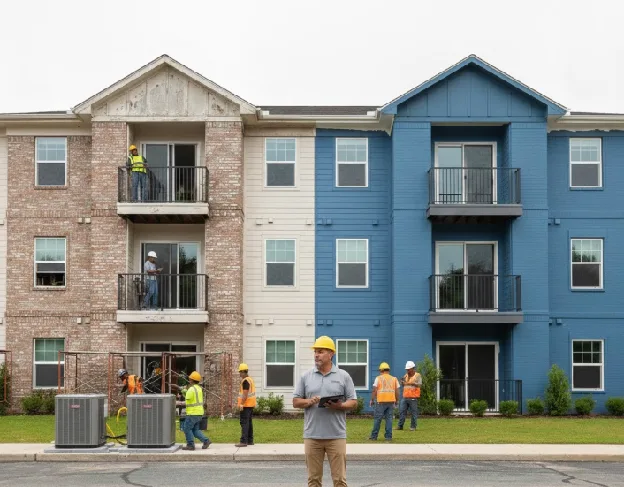
Multifamily value-add investing isn’t about “buying and hoping.” It’s about taking control. In the flipping world, you fix a kitchen to sell a house. In the multifamily world, you improve operations and physical condition to force appreciation. You aren’t just a renovator anymore; you are a professional operator.
Let us see how multifamily value-add financing works.
Categories of Multifamily Value-Add Opportunities
2-4 units multifamily (“SFR” bucket)
This category sits between a single-family residential (SFR) and “small multifamily”.
In the value-add multifamily financing world, the ‘small multifamily’ begins at 5 units. Private lenders consider the 2-4 units under SFR products. The 2-4 unit multifamily consists of duplex, triplex, and fourplex units. It accounts for approximately 17% of rental units.
There has been a significant lack of new supply in this category as compared to larger multifamily developments. Since supply is stagnant, value is created by maximizing the utility and efficiency of the existing footprint.
Want to know more about the SFR financing? Refer to Stormfield Capital’s SFR products.
5-49 units: The Small & Medium Play
This “small multifamily” category represents 17% of all U.S. rentals. Unlike massive apartment complexes, these properties are rarely run by pros. They are usually held by individual “mom-and-pop” owners who may have let maintenance slide or ignored operational efficiencies.
The Strategy: Professionalizing the “Mom-and-Pop”: Your edge isn’t just rent maximization, it’s tenant retention. You create value by solving years of “delayed maintenance.”
This means replacing aging HVAC systems and mechanicals, but also delivering the “flipper’s touch” through cosmetic upgrades. A fresh coat of paint, new flooring, and modernized kitchens can stabilize a building’s income.
Terner Center and others define small multifamily as 5-49 units.
50+ units: High-density / large multifamily
When you cross the 50-unit threshold, the game changes. You are no longer competing with individuals; 93% of these properties are owned by corporations.
While this is the most “professional” tier, it is currently the most vulnerable.
The “Luxury” Headwind: Large multifamily assets are currently navigating a “cresting supply wave.” Record-breaking new construction has flooded the market, pushing vacancies to 9.0% and stalling rent growth at a meager 1.5%.
The Reliability Gap: If you’re moving up from flipping, pay attention to the collections data. Despite their shiny facades, these large properties are trailing smaller assets in rent reliability. On-time payment rates sit at 81.7%, a full two points lower than the 2-4 unit category.
In this segment, the value-add strategy isn’t about pushing rents; it’s about surviving the competition.
The New Playbook for Multifamily Value Add: Adapting to the 2026 Market
The value-add multifamily strategies that worked five years ago will fail today. As a flipper, you know that “buying right” is everything. In multifamily, “buying right” now means shifting from a growth mindset to an operational mindset.
| Strategy | Traditional Value-Add (2015–2021) | Current Value-Add (2025–2026) |
|---|---|---|
| Primary Goal | Force appreciation via rent hikes. | Operational Resilience: Preserve NOI via expense control |
| The Project | Cosmetic Flips: Granite counters and “luxury” finishes. | Infrastructure: Green retrofits, deferred maintenance. |
| The Buy | Market Timing: Buy at market rate, rely on market rent growth. | Basis-Based: Buy a distressed property below replacement cost. |
| The Lease | Rent Pushing: Aiming for 10% annual hikes. | Defensive leasing: Prioritizing full units and high-quality tenants. |
The Bottom Line: The market-wide appreciation often compensated for operational gaps in the earlier cycle of multifamily value-add.
Today, that margin for error has vanished. Returns are no longer a product of market timing. They are a direct result of your ability to optimize Net Operating Income (NOI) with surgical precision.
The Multifamily Value-Add Execution Framework
Unlike speculative investing, the value-add strategy relies on a disciplined, linear execution. Each stage builds on the previous one, shifting the focus from market timing to operational control.
Step 1: Acquire an Underperforming Property
You find the true value-add opportunity where a property underperforms for reasons that can be corrected. Underperformance due to market failure is not counted as an opportunity.
Look for “rent gaps” compared to renovated neighbors, outdated interiors in high-demand submarkets, or bloated expenses caused by inefficient management.
If a property suffers from structural oversupply or declining demand, you are not looking at a value-add opportunity; you are looking at market risk.
Step 2: Validate Income and Capital Requirements
Before closing, you must look past the ‘pro-forma’, the seller’s best-case scenario, and conduct a forensic audit of the actual data. This means verifying the T-12 and bank statements to ensure the income reported on paper matches the cash hitting the bank.
In parallel, audit the rent roll to identify lease rollover concentrations.
If 40% of your tenants’ leases expire in the same month (a “concentration”), you face a massive vacancy risk. If you can’t renovate and re-lease those units quickly, you won’t have the cash flow to pay your mortgage.
Assess the true capital expenditure (CapEx) required to modernize the asset.
You are digging deep to find hidden costs. Does the roof have two years left or ten? Are the HVAC compressors failing? Is the plumbing cast iron or PVC?
T-12 (Trailing Twelve Months): A financial statement showing the property’s income and expenses over the most recent year.
Step 3: Engineering a Phased Renovation
A professional plan stops ‘capital leakage’ by synchronizing the sequence of improvements with your occupancy targets.
It must specify which units will be offline, the exact scope of operational upgrades, and how the rents will be repositioned over time.
Poor sequencing, like renovating interiors before fixing a leaking roof, usually becomes a painful reality during stabilization or refinancing.
Step 4: Repositioning for appreciation
In multifamily, valuation is a function of Net Operating Income (NOI), the income remaining after expenses but before debt service.
By executing your renovation and normalizing expenses, you “force” appreciation.
The delta between your acquisition NOI and your stabilized NOI represents the equity you have created through execution.
NOI (Net Operating Income): Income remaining after operating expenses, before debt service.
Step 5: Stabilize operating performance
Stabilization is the point where your plan becomes reality. It occurs when rents, occupancy, and expenses perform consistently without constant intervention.
At this stage, the property’s cash flow becomes predictable, proving the success of the repositioning strategy to future buyers or lenders.
Step 6: Refinance or exit the investment
The cycle concludes with the capital exit.
Once the asset demonstrates sustainable, stabilized income, you can transition into long-term, lower-cost debt or sell the property at a valuation supported by its new NOI.
Whether you return capital to investors or redeploy it into a larger deal, this step validates the entire value-add lifecycle.
Critical Metrics for the Multifamily Value-Add Investor
When transitioning from single-family flips to multifamily, your vocabulary must shift from “comps” to “cash flow metrics.”
These three indicators determine how a private lender views your deal and how much leverage you can safely carry.
NOI (Net Operating Income)
NOI represents the property’s core profitability before debt service and taxes. In the value-add world, NOI is your primary lever for creating wealth.
Every dollar you add to the bottom line, whether through rent premiums, utility bill-backs, or streamlined management, increases the property’s value exponentially based on the prevailing market cap rate.
How it’s calculated:
NOI = Gross Rental Income − Operating Expenses
(Excludes debt service, depreciation, and capital improvements)
Breakeven Occupancy
This metric defines the minimum occupancy level required to cover all operating expenses and debt obligations.
A low breakeven point is your insurance policy. It ensures the project remains solvent even during heavy renovation phases, construction delays, or temporary spikes in vacancy. For a graduating flipper, maintaining a conservative breakeven is the difference between a successful repositioning and a capital call.
How it’s calculated:
Breakeven Occupancy = (Operating Expenses + Debt Service) ÷ Gross Potential Income
DSCR (Debt Service Coverage Ratio)
DSCR measures the property’s ability to “cover” its mortgage from its own income.
While a value-add project may start with a thin ratio during the renovation phase, lenders look for a “stabilized DSCR” of 1.25x or higher. This ratio often acts as a ceiling on your leverage.
If the income isn’t there to support the debt, the loan amount will be capped, regardless of the property’s physical value.
How it’s calculated:
DSCR = NOI ÷ Annual Debt Service
Financing Built for Execution: Stormfield Capital
Stormfield Capital provides financing designed for Multifamily value-add projects. Their multifamily value-add loan program supports acquisition, renovation, repositioning, and stabilization:
- Loan amounts from $500,000 to $30 million+
- Up to 85% loan-to-cost
- Up to 70% loan-to-value
- 12 to 24 month loan terms
- Typical closing timelines are around 21 days
- In-house servicing from origination through payoff
If you already have a deal under review or are close to a contract, this is the right time to explore financing built for execution.


