
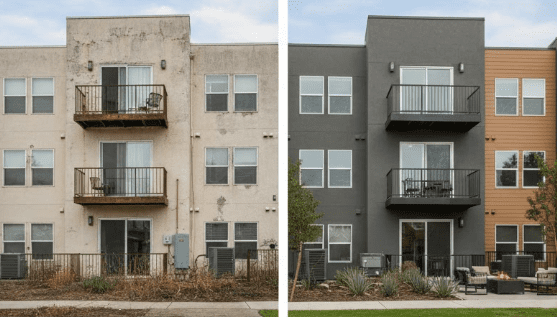
If a multifamily property isn’t earning what the market supports, it is a value-add opportunity. The property may stay occupied, but outdated interiors, limited amenities, and ageing systems prevent it from capturing the income it should.
What Is a Multifamily Value-Add Strategy?
A multifamily value-add plan improves an existing building and brings it up to what renters expect now. You target properties that could attract renters but show gaps in design, efficiency, or long-term upkeep: Each of the following fixes helps you raise the rent and cut down on maintenance.
- Upgrade the interiors and improve the amenities.
- Refresh the exteriors
- Address deferred maintenance.
Why Investors Pursue Value-add Real Estate?
A value-add real estate strategy gives you control over the property’s future performance. Instead of hoping for appreciation, you target improvements that matter to residents and operations.
Older buildings often reveal opportunities quickly, although not every older property is a strong value-add candidate. Some require major capital projects, such as full roof replacement or structural repairs, that stabilize the building but do not meaningfully increase Net Operating Income (NOI).
Net Operating Income (NOI) is the property’s income after subtracting all operating expenses—but before debt service, capital expenditures, and taxes. It reflects how much the asset actually earns from operations (rents + other income minus expenses).
You see where dated interiors suppress rents, where old systems inflate expenses (like inefficient boilers or water-wasting fixtures), and where poor lighting or neglected hallways keep residents from renewing.
Improved units and shared areas let you charge the same rent as other renovated buildings in the area.
Residents stay longer, maintenance pressure decreases, and the property becomes more efficient to run.
How Value-add Strategies Increase Returns
A good value-add plan improves rental income and makes the property run more reliably. Key drivers include:
Higher rent: Better interiors let you raise rents closer to what newer, competitive properties charge.
Better resident retention: Clean, updated buildings keep residents for longer stays. It cuts down your time and cost from vacancies.
Lower maintenance costs: Upgraded systems mean fewer emergency calls and prevent expensive, recurring issues.
Faster lease-ups after renovation: Modernized units attract quicker interest. It allows you to recover revenue without extended downtime.
Stronger property value: You get a higher price or better refinance terms when the property runs smoothly.
The Upgrades That Matter Most
The following are the upgrades that help improve the NOI:
Improve the interiors: Use better flooring and efficient lighting. Update kitchen layouts and refresh bathroom finishes. These upgrades help units stay competitive.
Exteriors that show consistent care: Fresh paint, maintained landscaping, organized walkways, and clear lighting improve first impressions.
Good amenities attract and keep renters: Laundry rooms, fitness areas, outdoor seating, pet options, and package solutions help attract and retain residents.
Capital improvements that protect stability: Reliable plumbing, electrical systems, HVAC, roofing, and structural components support long-term performance and reduce risk.
How Market Analysis Guides Value-Add Decisions
Only do improvements that people will pay for. Review comparable properties. Analyze rent trends and supply conditions. Survey resident expectations. By taking care of these you choose:
- Realistic rent goals
- Amenities that create value
- Sufficient finish levels
- When to go live with renovated units
This approach helps you avoid unnecessary costs.
Budgeting and Cost Control in Value-add Projects
Strong budgeting keeps the project on track. It means reviewing renovation costs, contractor bids, and material choices with discipline. This planning makes the job predictable and helps you rent faster. Effective planning includes:
- Create scopes based on detailed unit-by-unit assessments. E.g, replacing cabinets and countertops in older units, but only updating lighting in partially renovated units.
- Defined cost ranges for each improvement category. E.g.: setting target budgets for interior renovations, flooring replacements, lighting upgrades, exterior paint work, landscaping improvements, and common-area refreshes.
- Keep a cash reserve for unexpected repairs.
- Plan upgrades to make units rent-ready faster. Phase the work, coordinate contractors, and list finished units quickly to limit vacancy.
Common Mistakes to Avoid in Value-Add Projects
When managing a value-add project, experienced investors avoid these mistakes:
- Improving beyond local rent ceilings: Don’t spend money on upgrades that renters won’t pay for. Match your finishes to the rents you can realistically get in the area.
- Ignoring the operations: Renovations alone cannot correct an underperforming property. You need strong operation. Leasing, maintenance, rent collection, tenant communication, and expense control sustain NOI after the upgrades are done. Treat the entire value-add strategy as a business.
- Putting off big repairs: Fix major systems like roofing, plumbing, or electrical early. Delays only create bigger, more expensive problems later.
- Working without a detailed scope: A clear plan prevents confusion, budget overruns, and inconsistent work across units.
- Poor communication with the tenants: Keep residents updated during construction. Regular updates help maintain resident satisfaction and occupancy.
Value-Add Financing in Practice
Below is a real example of how financing supported a value-add project for a multifamily building in Massachusetts.
- Loan amount: $1,250,000
- Loan to cost: 73.53%
- As is loan to value: 66.67%
- After repair, loan-to-value: 63.29%
Available structures:
- 12-month term at 10.24% with an estimated initial payment of $7,680
- 18-month term at 10.99% with an estimated initial payment of $8,243
Once you have the property and value-add line items identified, you should try out various calculators to estimate the deal economics. Stormfield’s calculator can help you evaluate loan details for your projects.
CASE STUDY: Stormfield’s Eight-Unit Multifamily Project
A repeat Stormfield borrower and experienced real estate investor required a fix and hold loan to acquire, renovate, and refinance an eight-unit multi-family property in Dover, NH.
The sponsor has an extensive understanding of the New Hampshire real estate environment and invests primarily in the state’s submarkets, with 90%+ of their recently disposed of or currently held assets existing there.
Similar to their previous projects, the sponsor completed updates to the property’s units, including applying fresh paint, installing new finish flooring, and upgrading the kitchens and bathrooms before re-leasing the units at increased rates.
Upon stabilization, the borrower exits Stormfield’s loan with a long-term refinance via their local banking relationships.
Loan Details:
- LTC: 74%
- Stormfield financed 100% of the $110,000 renovation budget
- Purchase Price: $1,150,000
- Rehab: $110,000
- ARV: $1,475,000
Financing Your Value-Add Strategy
The Stormfield Capital “Multifamily Value-Add Loan” program is available for 5-100+ unit multifamily properties requiring rehab/renovation with a clear scope and ARV (after-repair value)
Stormfield offers:
- Loan amounts from $500,000 to more than $30 million
- Loan-to-cost ratios up to 85 percent
- Loan-to-value ratios up to 70 percent
- Terms from 12 to 24 months
- Closings in as little as 21 days
Once the property reaches higher income and occupancy levels, investors choose one of the following:
- Refinance: Move into long-term financing and keep the property for cash flow.
- Sell: If the market is right, sell after renovations.
Conclusion
A multifamily value-add strategy provides investors with a path to increasing income. It also improves resident satisfaction and strengthens long-term property performance. You turn underperforming assets into competitive, efficient properties by upgrading interiors, exteriors, amenities, and core building systems.
For investors ready to accelerate a project, Stormfield Capital’s value-add program provides the speed, reliability, and support needed to execute renovations and unlock higher NOI.


