
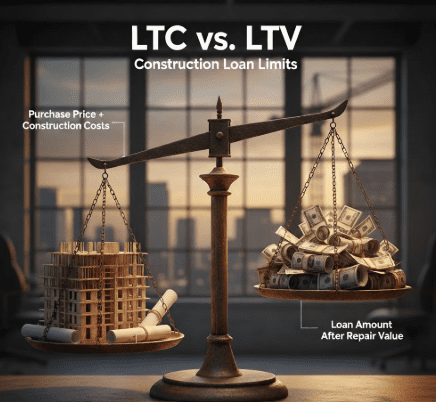
You will hear the terms Loan to Cost (LTC) and Loan to Value (LTV) a lot when working with private lenders. These terms aren’t the whole story. Underwriting is much more than LTV and LTC.
Underwriting also considers your experience, liquidity (cash on hand), the project scope, market conditions, your contractors, and your credit score.
However, LTC and LTV play a key role in defining the maximum loan amount. In other words:
LTC and LTV set the max loan amount, but they don’t replace the full underwriting process.
Let us examine these two terms in detail in the context of construction loans.
What Is LTC? (Loan-to-Cost)
Loan-to-Cost measures how much of your total project cost the lender will cover.
Formula
LTC = Loan Amount ÷ (Purchase Price + Construction/Rehab Costs)
Purpose
LTC protects the lender and the investor from project risks like:
- unrealistic budgets
- underestimated timelines
- lack of borrower equity
- cost overruns
Private lenders want the investors to maintain meaningful skin in the game. Therefore, they cap LTC around 80–85%, even when they fund 100% of construction costs.
What Is LTV? (Loan-to-Value)
Loan-to-Value compares the loan amount to the project’s After Repair Value (ARV).
Formula
LTV = Loan Amount ÷ Estimated ARV
Purpose
LTV protects the lender if values drop. Whether the project finishes or is foreclosed, the lender needs to know the property can sell with enough equity cushion.
What is an Equity Cushion?
An equity cushion is the built-in safety buffer between the property value and the loan amount. For example, if a property will be worth $500,000 when finished and the lender only lends $350,000, the $150,000 gap is the lender’s protection if anything goes wrong.
Since ARV must reflect current comparable sales, the LTV limit often becomes the controlling cap in new construction, especially in strong markets where values rise faster than costs.
However, in many projects, LTC ends up being the tighter limit. High construction budgets, borrower experience, liquidity, and project complexity can all lead the lender to size the loan based on cost instead of value.
Which Matters More: LTC or LTV?
Both matter, but the smaller number always wins.
Once a construction project is approved through underwriting:
- LTC sets the cost-based ceiling
- LTV sets the value-based ceiling
Every lender uses LTC and LTV to size construction loans because they protect against different risks.
Real Loan Example: New Construction in Worcester, MA
All data below was sourced directly from a sample loan file generated using Stormfield Capital’s pre-qualification platform. You could also try out the calculations today.
Project Summary
- Location: Worcester, MA
- Type: 2–4 unit new construction
- Land purchase: $100,000
- Construction budget: $520,000
- Estimated ARV: $750,000
Stormfield Program Limits
For Residential New Construction, Stormfield finances:
- Up to 85% of the land/acquisition price
- 100% of construction costs
- Not to exceed 70% of ARV
Which one influences the max loan amount?
Let us look at a few scenarios:
Scenario #1: LTV sets the cap
Given below is a screenshot of the loan details calculator from Stromfield Capital.
You could enter any of your scenarios and estimate your loan options.
In this sample scenario, details for a residential value-add Multi-family (2-4 Units) loan have been entered. Look at the values entered for the experience, credit score, purchase price, rehab cost, and after-repair value.

For this scenario #1, the calculated pre-qualified loan details are:
- Maximum allowed loan amount: $525,000.
- Out of which, $520,000 has been earmarked for construction funding as per the draw schedule.
- Your initial disbursement at the time of closing will be $5000.
The LTC and LTV values are as follows:
LTC = 525,000/620,000 = 84.7%
LTV = 525,000/750,000 = 70%
It is the LTV that sets the cap in this scenario.

Scenario#2: LTC sets the cap
Consider the scenario in which the market comparables indicate a higher ARV of $800,000. The Stormfield Capital’s calculator shows a total loan amount of $527,000 for this scenario.
The LTC and LTV values are as follows:
LTC = 527,000/620,000 = 85%
LTV = 527,000/800,000 = 65.9%
Notice how it is the LTC that sets the cap in this scenario.
Beyond LTV and LTC
Required Equity (or “Skin in the Game”) is the cash you must put in to bridge the gap between the total project cost and the maximum loan allowed by the LTC/LTV rules. Private lenders also insist that no “zero-down” deals are permitted. It is in your benefit that you have sufficient liquidity to cover the required down payment, reserves, and interest carry.
Deal economics: Lenders also calculate the deal’s gross profitability. In the scenario shown in the picture, the gross profitability of 18% is below the minimum required 20% and hence needs adjustments.

Credit Score Experience: Lenders prefer borrowers applying through an entity (LLC or Corporation). Credit score and prior experience matter for Residential New Construction.

Stormfield combines a disciplined approach with speed. We work closely with you to match your experience and deal economics to our lending standards.
Conclusion
LTC and LTV are the two core ratios that determine maximum construction loan sizing.
They don’t replace full underwriting, but they define the boundaries of what a lender could offer once a project qualifies.
The examples demonstrate how different factors, such as your experience, credit score, deal economics, and liquidity, together influence the loan details.
If you are planning a new construction and want a lender who combines speed with disciplined underwriting, Stormfield Capital is built for that kind of work.
See which loan actually fits your flip.
Flipping succeeds when money flows at the same pace as the work. A structured fix & flip loan keeps your project moving, while generic hard money often slows it down.
Table of Contents
Stormfield Capital is a direct balance-sheet lender offering financing solutions for residential investment projects, including fix and flip, bridge, and new construction loans. With fast decisions, consistent draw processes, and reliable funding, Stormfield supports investors across the Northeast and other key U.S. markets.
If you’re evaluating financing for an upcoming flip, Stormfield’s team can help you compare your options and understand the best structure for your project. Contact us to discuss your deal or get a quick quote.
LTC vs LTV FAQs
1What’s the difference between LTC and LTV?
LTC measures loan vs. total project cost.
LTV measures loan vs. completed value (ARV).
Loan size is based on the lower of the two.
2When is loan-to-value (LTV) determined on a construction loan?
In a construction loan, LTV is determined early in the underwriting process using an as-completed appraisal of the project’s future value. It’s not just at the end of construction. Before a loan is approved, lenders will estimate what the property will be worth once construction is finished (using comparable sales, market data, and specs) and calculate the LTV ratio using that projected value.
This upfront LTV determination helps lenders gauge value risk and downside protection, while LTC measures cost risk. Even after closing, some lenders will revisit valuations, especially if there’s a take-out refinance or exit strategy, but the initial LTV test happens before the loan is funded and is a key part of sizing the loan.
3How much equity do I need?
Borrowers typically contribute 20–35% of the total project cost, depending on ARV strength and experience.
4Can first-time investors qualify?
Not for new construction. Fix & Flip programs accept first-timers, but ground-up deals require verified experience.
5How can I quickly estimate my maximum loan?
Use Stormfield’s calculator to estimate your maximum loan. It works without a credit pull. You key in your scenario, and it generates the loan details.
6How does LTC vs LTV affect how much I can borrow?
LTC and LTV directly determine your maximum loan amount, because lenders will size the loan based on the lower of the two ratios.
Even if a lender allows a high LTC based on project costs, a lower LTV driven by the completed appraisal can still cap the loan. Conversely, a strong valuation may not increase loan proceeds if total project costs push LTC beyond the lender’s limit.
This is why borrowers often calculate both ratios early: to understand which constraint will ultimately limit borrowing capacity.
7How do lenders use LTC and LTV to assess risk?
Lenders use LTC and LTV together to control different types of risk in a construction loan.
LTC limits cost overrun risk by ensuring the borrower has sufficient equity invested in the project. LTV limits market and valuation risk by capping exposure relative to the property’s completed value.
By underwriting to both ratios, lenders protect against projects that are either over-budget (high LTC) or over-valued (high LTV). The final loan size is typically determined by the more conservative of the two.


